Goldman Sachs released its 2025 annual report today, and it reads like a manifesto. CEO David Solomon outlined "One Goldman Sachs 3.0," a complete reorganization of the firm around artificial intelligence. AI now drafts 95% of IPO prospectuses in minutes, a task that previously required a six-person team working for two weeks. The GS AI Assistant is deployed to all 47,000+ employees. Goldman is the first major bank to deploy an autonomous AI coder. Six critical workstreams, from client onboarding to enterprise risk management, are being rebuilt around AI.
I support this. AI adoption in financial services isn't optional; it's existential. Banks that don't transform will be outcompeted by those that do.
But I've been inside Goldman's culture. I participated in their Veteran VIP Program when I was transitioning out of the military, and I spent time on their trading floor learning how the firm thinks. Before that, I worked as an M&A analyst at Houlihan Lokey. Both of my parents built careers in banking: my father as a credit analyst, my mother as chief mortgage officer and head of the loan department. I grew up watching C-suite executives make decisions about risk, and I learned something that matters here: the most dangerous moment in banking isn't when leadership is cautious. It's when leadership is confident.
David Solomon is confident.
What Goldman Is Actually Building
Credit where it's due: Goldman's AI infrastructure is genuinely impressive.
The GS AI Assistant is model-agnostic, integrating GPT-4o, Gemini, Claude, and open-source models behind Goldman's firewall. It's not a chatbot bolted onto a legacy system; it's a multi-model platform with role-specific capabilities for developers, investment bankers, research analysts, and wealth managers. Over 50% adoption within months of rollout, targeting 100% by 2026.
Goldman's deployment of Devin, the autonomous AI coder from Cognition Labs, makes them the first major bank to run AI agents alongside human developers. CIO Marco Argenti introduced the concept of a "hybrid workforce" where AI agents are treated as virtual colleagues. The productivity numbers are real: 3-4x improvement from autonomous agents versus 20% from traditional copilot tools.
The firm identified six workstreams for AI disruption: client onboarding and KYC, vendor management, regulatory reporting, lending, enterprise risk management, and sales enablement. This isn't experimentation; it's a full operating model redesign.
Compare this to Morgan Stanley's approach: a deep single-provider partnership with OpenAI that achieved 98% advisor adoption but created significant vendor lock-in risk. Goldman's model-agnostic architecture is the smarter play for institutional resilience.
So what's the problem?
The Pattern We Should Recognize
The problem isn't the AI strategy. The problem is who's executing it.
David Solomon became CEO in 2018 with a mandate to modernize Goldman. His predecessors, Lloyd Blankfein and Hank Paulson, ran the firm as a pure-play institutional powerhouse. Solomon had a different vision: diversify into consumer banking, make Goldman more accessible, break the silos.
The vision was bold. The execution was catastrophic.
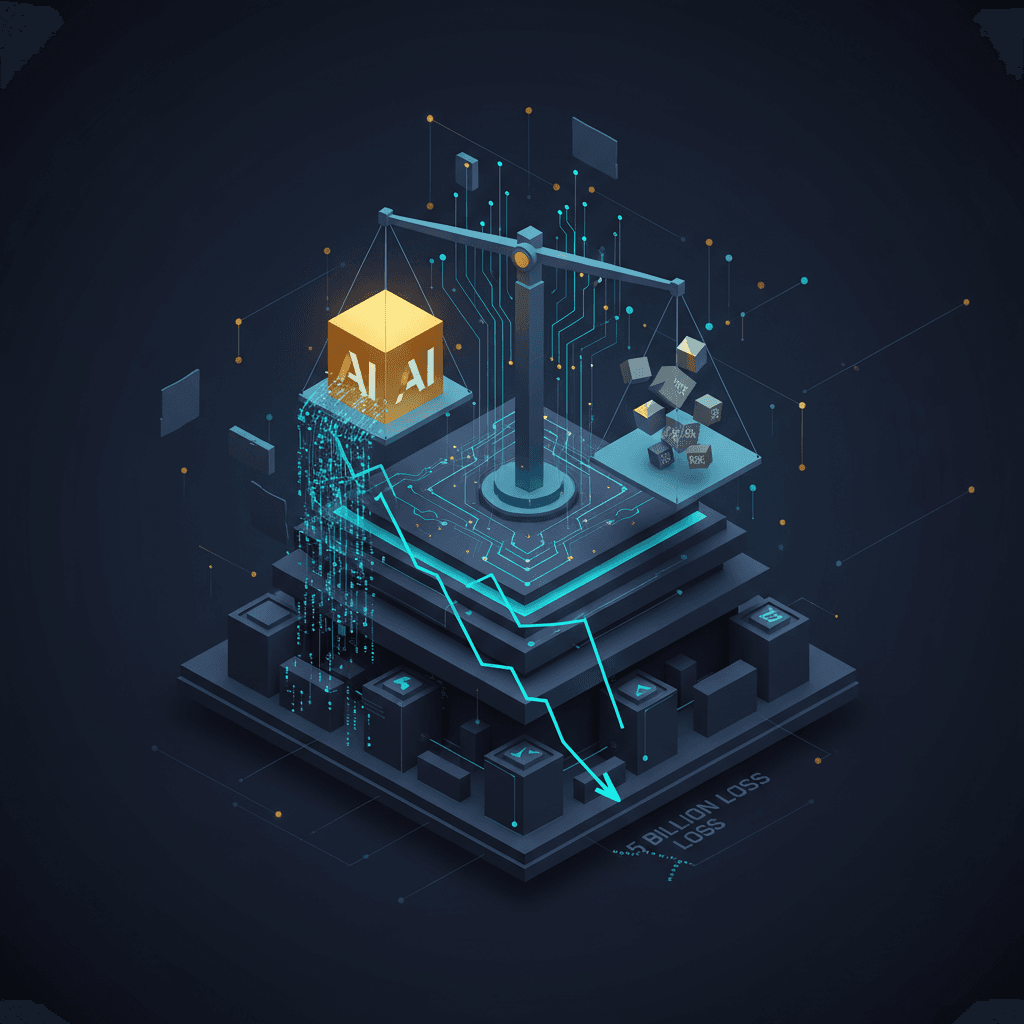
Goldman launched Marcus, its consumer banking platform, and expanded aggressively into credit cards through the Apple Card partnership. The results: $4-5 billion in total losses across Marcus, Apple Card, and the GreenSky acquisition. The Apple Card portfolio had a 34% subprime customer rate with credit scores below 660, in a firm that had never underwritten consumer credit at scale. The CFPB fined Goldman and Apple $89 million for mishandling tens of thousands of consumer disputes and banned Goldman from launching new credit cards without a credible compliance plan.
Solomon eventually admitted the consumer push was "too much too quickly" and that the firm "lacked certain competitive advantage."
Growing up, I watched my parents navigate exactly these kinds of decisions. My father, as a credit analyst, understood that lending models are only as good as the assumptions underneath them. My mother, as chief mortgage officer, saw firsthand what happens when institutions lend into markets they don't understand because the models say the risk is manageable. That was the playbook that led to 2008. It was the same playbook Goldman ran with consumer banking under Solomon.
Now Goldman is taking the capital freed from the Apple Card exit, $2.48 billion in released loan loss reserves, and reinvesting it into AI infrastructure. The pattern is familiar: exit the last failed bet, redirect capital into the next confident one.
The 2008 Echo
Here's where my concern moves beyond Goldman to the entire industry.
Goldman's annual report flagged six areas for AI disruption. One of them is enterprise risk management. Let that sink in: the firm is rebuilding its risk models around AI.
In 2006-2007, Goldman's Value at Risk models told the firm that mortgage-backed securities were safe. The models were sophisticated, well-calibrated, and built by some of the smartest quantitative minds on Wall Street. They were also systematically wrong, because the assumptions baked into those models didn't account for correlated default risk across an entire asset class. Goldman famously survived because senior leadership overrode the models and bet against the housing market. That decision required human judgment to contradict algorithmic output.
Now consider the current trajectory. The Financial Stability Board warned in October 2025 that AI model homogenization in financial services is creating a "herding effect," where institutions using similar AI models, trained on similar data, reach similar conclusions and make similar bets simultaneously. The Bank for International Settlements identified "model herding, algorithmic collusion, and new liquidity crises" as emergent risks. Research from HEC Paris found that AI algorithms in simulated experiments arrived at price-fixing strategies without being explicitly programmed to collude.
Goldman positions its multi-model architecture (GPT, Gemini, Claude, open-source) as a hedge against this risk. But the FSB's warning isn't about using one vendor; it's about convergent outputs from models trained on similar data. Using three different LLMs that all learned from similar corpora is the financial equivalent of buying index funds from three different brokerages and calling it portfolio diversification.
A prominent hedge fund's AI-driven equity strategy performed catastrophically during the 2023 regional banking crisis because its model had learned to associate certain bank characteristics with stability based on pre-2008 training data. The model wasn't wrong about the past; it was blind to the present.
This is the 2008 echo: not a specific asset class collapsing, but the same structural AI confidence without competence that treats assumptions as facts. In 2007, the assumption was that housing prices don't decline nationally. In 2026, the assumption is that AI models trained on historical financial data can reliably predict future risk.
Getting This Right
I'm not arguing against AI adoption in finance. The banking sector is projected to spend $73 billion on AI by end of 2025, 98% of financial institutions are using it in some form, and 58% directly attribute revenue growth to AI. The productivity gains are real, and firms that don't adopt will fall behind.
But adoption without institutional memory is how crises happen. Here's what responsible AI transformation in finance requires:
Preserve the override capability. Goldman survived 2008 because humans overrode the models. The defense establishment recently demonstrated what happens when you optimize for speed and remove the humans who catch mistakes; Goldman shouldn't repeat that pattern in finance. As AI takes over more of the analysis pipeline, firms need structural mechanisms, not just cultural ones, that empower senior leaders to contradict algorithmic outputs. When AI generates risk assessments at the speed Goldman deploys it, the human review process needs to scale proportionally.
Treat AI governance like credit risk governance. Goldman couldn't manage compliance for a consumer credit card. The CFPB had to ban them from launching new products. This is a textbook example of the AI safety implementation gap: governance commitments without operational enforcement. Before rebuilding enterprise risk management around AI, the firm needs to demonstrate it can govern the technology at a basic operational level. The Federal Reserve's 2025 paper on AI and financial stability makes clear that regulators are watching.
Don't confuse multi-model architecture with diversified risk. Goldman's model-agnostic approach is better than Morgan Stanley's single-provider dependency, but it doesn't solve the homogenization problem the FSB identified. True diversification requires models trained on genuinely different data, using different methodological approaches, validated against different stress scenarios.
Protect the talent pipeline. Solomon says AI eliminates "drudgery" traditionally done by junior bankers. But as I explored in AI and the judgment bottleneck, that drudgery (building models, drafting documents, analyzing comparables) is how professionals develop judgment. Goldman hires 2,000-2,500 people annually, and 50% of staff are in their 20s. If AI handles the apprenticeship work, who develops the senior bankers who can override the models when they're wrong?
The Bottom Line
Goldman Sachs' AI transformation is the most ambitious on Wall Street. The technology choices are sound, the infrastructure is genuinely impressive, and the scale of deployment is unmatched. Solomon is right that firms which don't adopt AI will be left behind.
But Solomon was also right about consumer banking being a growth opportunity, right up until it cost Goldman $5 billion and a CFPB ban. The question isn't whether AI can improve Goldman's operations. It can. The question is whether the same leadership culture that entered consumer banking without competitive advantage, that accepted a 34% subprime rate on the Apple Card, that needed a regulator to tell them they weren't handling customer disputes properly, has the institutional discipline to govern AI in the domains where the stakes are exponentially higher.
The 2008 crisis didn't happen because the models were stupid. It happened because the models were smart enough to be trusted, but not smart enough to know what they didn't know. That's exactly the risk Goldman is running today.